Montenegro Is Quietly Becoming the Mediterranean’s Most Interesting Superyacht Stop
The superyacht crowd is quietly rerouting to the Adriatic. Here's why Montenegro is becoming the Mediterranean's most compelling new stop.

For years, the superyacht circuit followed the same well-worn circuit. Monaco to Saint-Tropez, a drift along the Côte d’Azur, perhaps a swing through the Balearics. Montenegro barely registered as a footnote. But this is changing fast.
Porto Montenegro, tucked inside the Bay of Kotor on the Adriatic coast, has spent the better part of a decade quietly building the infrastructure to compete at the top end of the market. With over 650 berths capable of handling vessels up to 250 metres, a full refit facility, and a marina village that now includes branded residences, fine dining, and proper provisioning, it has arrived. What it has not done—yet—is become expensive.
The Numbers That Matter
Berth fees in Porto Montenegro run at roughly a quarter of equivalent costs in Monaco or Portofino. For an owner operating a 60-metre vessel across a summer season, the math is difficult to dismiss. Charter guests are noticing too: itineraries that once treated Montenegro as an exotic detour are now building entire Adriatic legs around it.
The cultural infrastructure is catching up. Early 2026 saw the opening of Folie and Attiko, two new beach clubs that bring a credibly international hospitality register to the marina. Neither is modest in ambition—both are pitched squarely at the crowd that summers in Mykonos or Ibiza but is beginning to wonder whether those destinations still offer much that feels undiscovered. A growing calendar of private events, pop-ups, and season-opening parties is adding social texture to what was, until recently, a marina with impressive hardware but limited atmosphere.
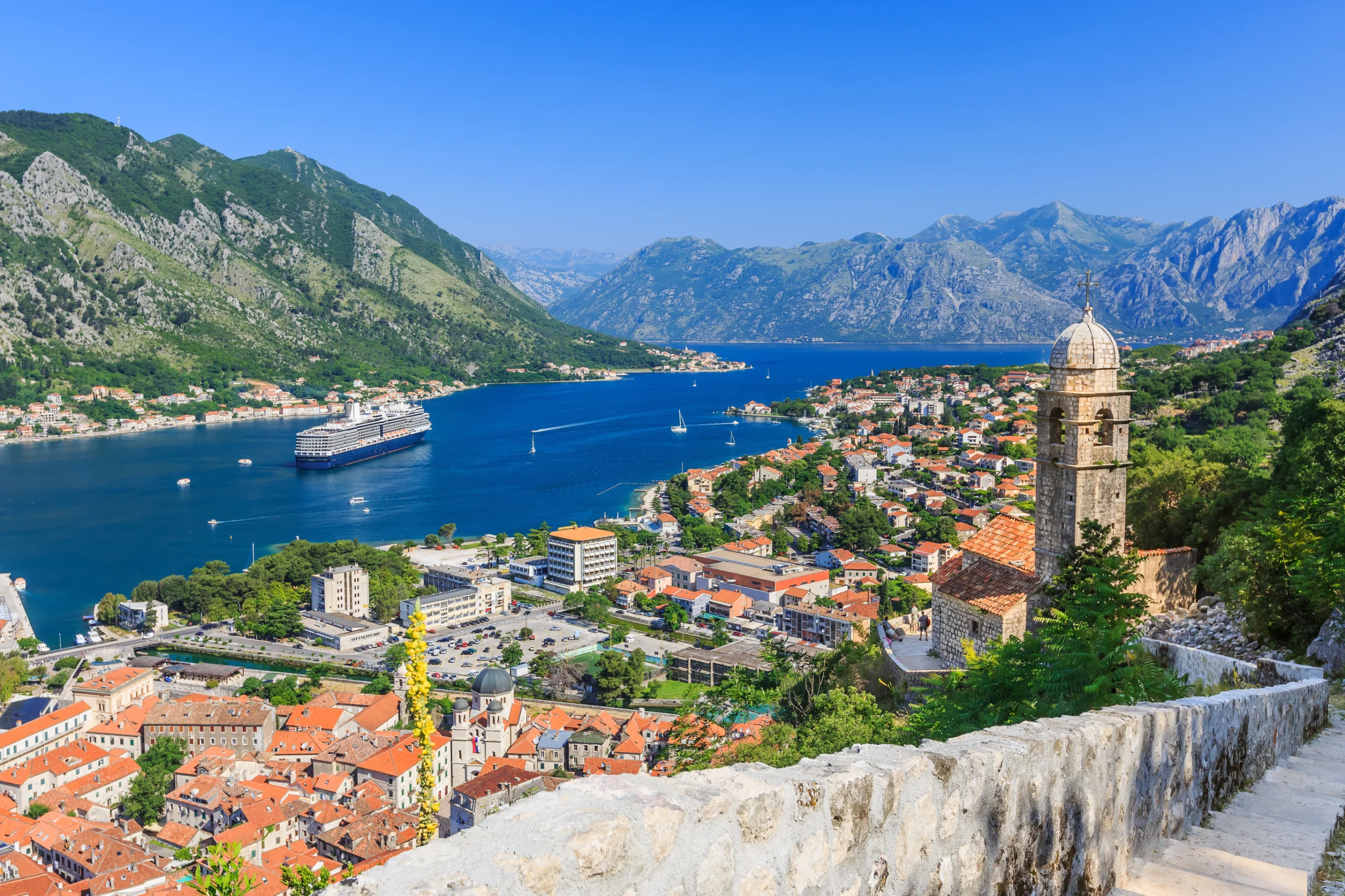
Photo by © Sorin Colac | Dreamstime.com
Fjord Country
The geography, of course, has always been the argument. The Bay of Kotor is not a bay in any ordinary sense: it is a drowned river canyon, a Nordic fjord transposed to the Adriatic, its steep limestone walls dropping to water the colour of mercury at dusk. The walled medieval town of Kotor sits at its innermost point—a UNESCO World Heritage Site that receives a fraction of the visitor footfall of Dubrovnik, an hour up the coast. Beyond the bay, the wider Montenegrin coastline offers an Adriatic that rewards exploration. Think secluded anchorages, unhurried fishing villages, and waters that have not yet been fully charted by the main charter fleets.
The “New Monaco” Comparison
The “new Monaco” comparison has been doing the rounds for several years, but it invites reasonable scepticism. Monaco is Monaco: its gravitational pull is social and financial, not merely geographical. Montenegro cannot replicate that. What it can offer is the combination that has become hard to find elsewhere: world-class infrastructure at accessible prices, in a setting that still has something left to reveal. For a growing segment of the superyacht market, that is the more compelling proposition.
The summer of 2026 will be a useful test. With Folie and Attiko open, the marina at capacity for much of July and August, and charter demand visibly shifting toward the eastern Adriatic, Montenegro’s moment appears to be less a prediction than a present tense.
More articles
Ready to set sail?
Discover the perfect yacht charter for you — effortlessly with Yacht.com.


